
Unify Your Data Platform with Microsoft Fabric
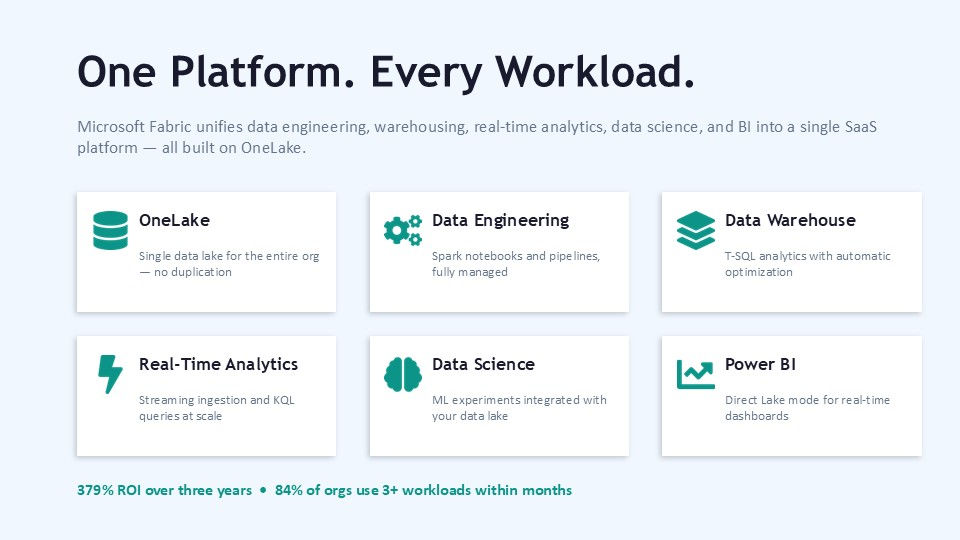
Data drives every decision in today’s organizations. Yet many businesses struggle with fragmented data systems, slow analytics, and limited access to insights. Microsoft Fabric offers a solution to unify your data platform, enabling faster, smarter decisions and unlocking real-time insights across your entire data estate.
This post explores how Microsoft Fabric helps modernize your data and analytics environment. You will learn how to unify your data, transform it to power AI, support teams with analytics, and govern your data securely. We will also highlight real-world examples of organizations achieving measurable results with Microsoft Fabric.
Unifying Your Data Estate
Many organizations face challenges with data scattered across multiple systems, formats, and locations. This fragmentation slows down decision-making and limits the value extracted from data. Microsoft Fabric addresses this by providing a unified data platform that brings together all your data sources into a single, integrated environment.
With Microsoft Fabric, you can:
Connect data from cloud, on-premises, and edge sources
Store structured and unstructured data in one platform
Use consistent data models and metadata across teams
Simplify data access with a unified interface
This unified approach reduces complexity and enables faster data preparation and analysis. For example, a retail company using Microsoft Fabric was able to combine sales, inventory, and customer data from multiple systems into one platform. This allowed their analysts to generate insights faster and improve inventory management.
Transforming Data to Power AI Solutions
Artificial intelligence depends on high-quality, well-organized data. Microsoft Fabric helps transform raw data into formats that AI models can use effectively. It supports data cleansing, enrichment, and feature engineering within the platform.
Key capabilities include:
Automated data transformation pipelines
Integration with Azure AI and machine learning tools
Support for real-time data streams to enable live AI predictions
For instance, a healthcare provider used Microsoft Fabric to prepare patient data for AI models that predict health risks. By automating data transformation, they reduced manual work and improved prediction accuracy, leading to better patient outcomes.
Supporting Teams with Analytics and Insights
Data is only valuable when teams can access and understand it. Microsoft Fabric empowers business users, analysts, and data scientists with tools to explore data and generate insights without waiting for IT.
Features that support teams include:
Self-service analytics with easy-to-use dashboards and reports
Collaboration tools to share insights across departments
Integration with Microsoft Power BI for rich visualizations
A financial services firm adopted Microsoft Fabric to give their sales and marketing teams direct access to customer analytics. This enabled faster campaign adjustments and improved customer targeting, increasing revenue by 15% within six months.
Governing and Protecting Your Data Seamlessly
Data governance and security are critical as organizations handle increasing volumes of sensitive information. Microsoft Fabric includes built-in governance features to protect data while ensuring compliance with regulations.
Governance capabilities include:
Role-based access controls to restrict data access
Data classification and labeling for sensitive information
Audit trails and monitoring for compliance reporting
For example, a manufacturing company used Microsoft Fabric’s governance tools to comply with industry regulations while enabling secure data sharing between partners. This balance of security and accessibility helped them accelerate product development cycles.
Understanding the Opportunity AI Presents and Why Data Is Its Foundation
AI offers tremendous potential to improve decision-making, automate processes, and create new business value. However, AI’s effectiveness depends on the quality and accessibility of data. Microsoft Fabric places data at the center of AI initiatives by providing a platform that integrates data management and AI capabilities.
By unifying data and enabling seamless transformation, Microsoft Fabric helps organizations build AI solutions that deliver real-time insights and actionable outcomes. This foundation is essential for businesses aiming to stay competitive in a data-driven world.
Overcoming Common Challenges That Hinder Digital Transformation
Many digital transformation efforts stall due to data silos, inconsistent data quality, and lack of user adoption. Microsoft Fabric addresses these challenges by:
Breaking down data silos with a unified platform
Ensuring data quality through automated transformation and governance
Providing user-friendly analytics tools to increase adoption
These features help organizations move beyond pilot projects to scale digital transformation across the enterprise.
Real-World Examples of Microsoft Fabric Impact
Leading organizations across industries have used Microsoft Fabric to transform their data estates and achieve measurable results:
A global retailer reduced data preparation time by 40%, enabling faster inventory decisions
A healthcare provider improved AI model accuracy by 25% through better data transformation
A financial firm increased sales revenue by 15% by empowering teams with real-time analytics
A manufacturer accelerated product development by securely sharing data with partners
These examples demonstrate how Microsoft Fabric delivers practical benefits by unifying data, supporting AI, enabling analytics, and ensuring governance.
#MicrosoftFabric #PowerBI #AI #GenAI #DataPlatform #Azure #Analytics #DigitalTransformation #RayMinds #DataStrategy #BI


Comments